
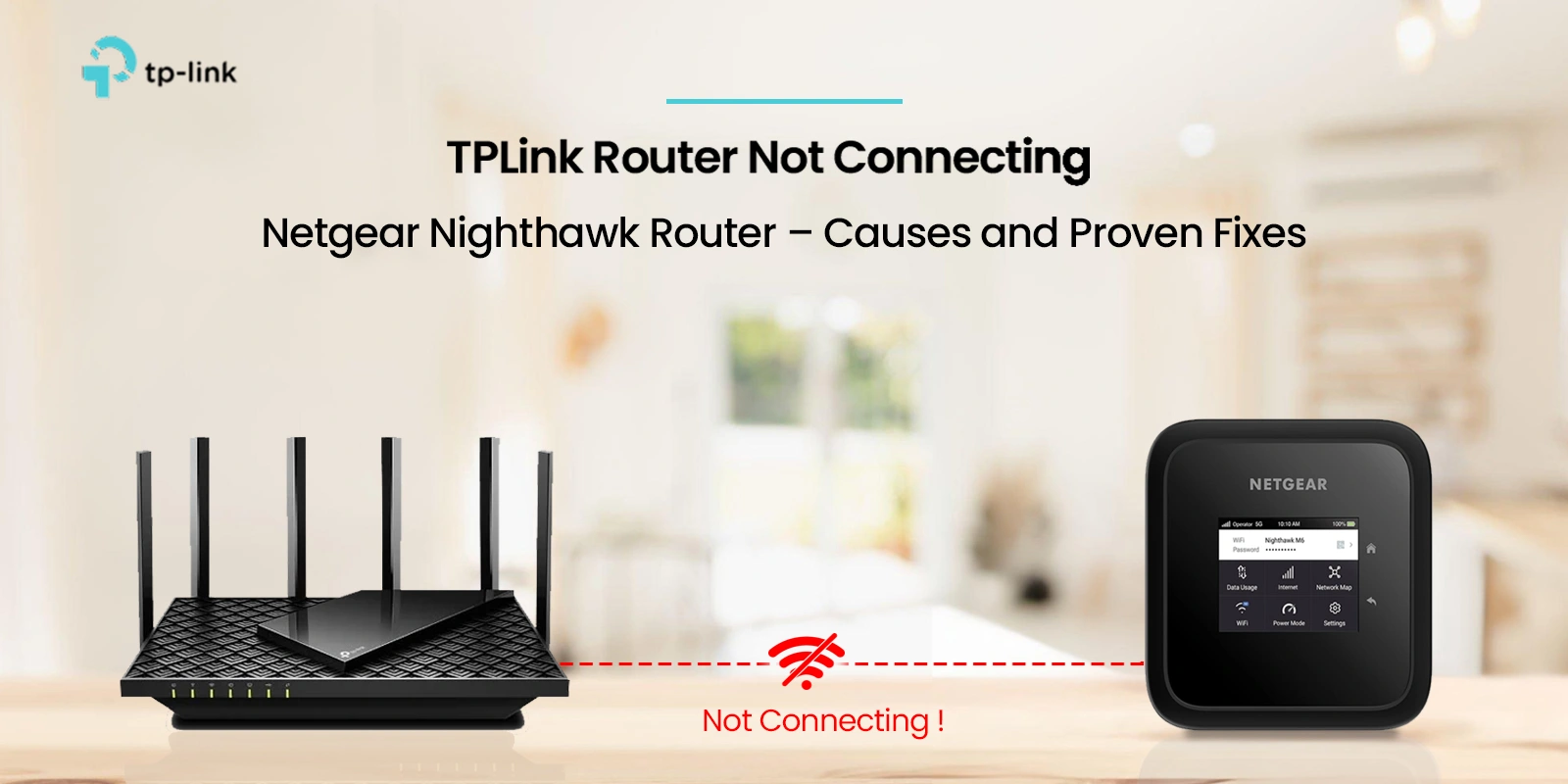
TPLink Router Not Connecting Netgear Nighthawk Router – Causes and Proven Fixes
Running two routers in one network is far more common today than it was a few years ago. According to Statista, over 65% of home networks now use more than one networking device, often combining routers, extenders, or mobile hotspots. Because of this trend, users increasingly face situations where devices from different brands must work together. One such issue appears when a TPLink router not connecting Netgear Nighthawk router disrupts internet access or local networking.
While the technical issue may seem complex at first, most of the time it relates to routing roles, IP addressing, or firmware, as opposed to hardware. This kind of knowledge allows one to solve the problem without resorting to a hardware change or soft reset.
Why TP Link and Netgear Nighthawk Routers Clash in the Same Network
By design, Netgear Nighthawk routers are to act as main gateways. They perform WAN authentication, NAT translation, DHCP assignment, and firewall enforcement. TPLink routers are added later, mostly to extend the coverage area and to create some segmented networks.
When a problem arises from a TP Link router not connecting Netgear Nighthawk router, the most obvious cause is due to the fact that both devices try to perform routing at the same time. This creates double NAT, IP pool overlapping, and conflict in paths by the gateways.
In a healthy network:
- Only one device should act as the main router
- Secondary routers should operate in Access Point or bridge mode
- DHCP must run from a single source
Ignoring these rules leads directly to the TPLink router not connecting Netgear Nighthawk router.
TP Link Router Not Connecting Netgear Nighthawk Setup: Where It Goes Wrong
Many cases of a TPLink router not connecting Netgear Nighthawk router occur in the initial stages of connecting. People normally connect their TPLink routers before they are done with the Netgear Nighthawk setup. This, therefore, gives a TPLink router an invalid or a temporary IP address. The correct IP address is 192.168.1.1.
This is why TP Link router not connecting Netgear Nighthawk setup issues appear even though cables are connected correctly. The order of configuration matters.
The TPLINK router tries to open a WAN connection, and in the Nighthawk router, this connection is blocked or gets an IP address that cannot be routed out.
The Role of tplinkwifi.net in Troubleshooting
To resolve most compatibility issues, direct access to the TPLink admin interface is essential. This is done through tplinkwifi.net, which allows users to control routing behavior.
From tplinkwifi.net, users can:
- Switch TPLink router from Router Mode to Access Point Mode
- Disable the TPLink DHCP server
- Assign a static management IP
- Align subnet ranges with the Netgear router
Skipping this configuration step almost guarantees repeated failures.
TP Link Router Not Connecting Netgear Nighthawk Modem Scenarios
In some setups, the Netgear Nighthawk router and modem combo becomes a modem and a router. Then, with the connection of the TPLink router, the TPLink router will be placed behind carrier-grade NAT.
This leads to the TPLink router not connecting Netgear Nighthawk modem problem, where:
- Internet Access may appear active
- Devices will not be able to communicate effectively
- Port forwarding and applications break
The TPLink router must therefore be set to Access Point mode in order for it to stop its NATing.
TPLink Router Not Connecting Netgear Nighthawk WiFi: RF and SSID Conflicts
Wireless conflicts are another overlooked cause. When both routers broadcast WiFi using the same SSID and channel width, clients may roam incorrectly.
This leads to TPLink router not connecting Netgear Nighthawk wifi complaints, where:
- Devices drop connections
- Speeds fluctuate
- Some devices appear offline
Separating SSIDs during testing helps identify whether the issue is RF interference or routing-related.
TP Link router not Connecting Netgear Nighthawk Firmware Update: A Hidden Trigger
Firmware updates improve security and performance, yet they also change default behavior. Many users experience TPLink router not connecting Netgear Nighthawk firmware update issues after upgrading one device but not the other.
After updates:
- DHCP scopes may reset
- Firewall rules may tighten
- Bridge settings may revert
This explains why connectivity breaks suddenly, even though nothing else changed.
TPLink Router Not Connecting Netgear Nighthawk M6 (Mobile Hotspot)
Netgear Nighthawk M6 works in a different manner from traditional routers. It supports mobile NAT and basic bridge modes. This is the reason why the TP Link router not connecting Netgear Nighthawk M6 problem is so common.
The carrier-level NAT interferes with the routing process when there is a second router in the network. In such scenarios, the TPLink router has to be operated in a manner where there is absolutely no full router operation. The best and most stable mode in such a situation is the Access Point mode.
TP Link Router Not Connecting Netgear Nighthawk WiFi Extender Conflicts
When users add a TPLink router while also using a Netgear extender, network loops can form. This causes TP Link router not connecting Netgear Nighthawk wifi extender.
Extenders expect a single upstream router. Introducing a second router breaks their logic and often leads to dropped packets and broadcast storms.
Step-by-Step: How to Fix TP Link Router Not Connecting Netgear Nighthawk Router
Use this structured approach:
- First, power off both routers
- Next, power on the Netgear Nighthawk and confirm internet access
- Then, connect the TPLink router via Ethernet
- After that, access tplinkwifi.net in a web browser
- Next, switch the TPLink router to Access Point mode
- Additionally, disable DHCP on the TPLink router
- Finally, reboot both devices
This sequence resolves the majority of TP Link router not connecting Netgear Nighthawk router cases.
Why Double NAT Breaks Everything
Double NAT is the most common reason for failure. It stops incoming traffic, prevents device discovery, and impacts applications.
If it comes up that both routers appear to be utilizing private WAN IP addresses, this means that double NAT is present, and removing it fixes the TPLink router not connecting Netgear Nighthawk router immediately.
When Resetting the TPLink Router Is Justified
Resetting should be a last resort. Perform resetting steps only if:
- You cannot reverse the configuration changes
- Or suspect firmware corruption
- Lose admin access
After the reset, configuration must begin again via tplinkwifi.net.
Final Thoughts
TP Link router not connecting Netgear Nighthawk router is not a compatibility issue. It is nearly always a configuration issue or related to a routing role. In today’s world, it is necessary to know which component is responsible for managing the routing, DHCP, or NAT.
By understanding setup order, using tplinkwifi.net correctly, handling firmware changes carefully, and accounting for special cases like the Netgear Nighthawk M6, users can build stable mixed-brand networks.
When configured properly, TPLink and Netgear devices work together reliably, delivering strong coverage, consistent speeds, and long-term stability.